THE METRIC TRAP HOW A 50-YEAR-OLD STRATEGY IS KILLING ACADEMIC FREEDOM By Scott Douglas, CPFA Southern Regional Representative The institution of tenure is, as ever, in the crosshairs. But the latest offensive—tying tenure to workload […]
Join us on Zoom May 16, 2026 for CPFA's Annual Conference, CPFA: Moving Forward. Register now online. It's open and free to all part-time faculty and allies.
By Scott Douglas, CPFA SoCal Regional Representative The movement for a one-tier faculty system in California Community Colleges (CCC) is gaining momentum—and rightly so. Its goal is to eliminate the structural inequities between part-time and […]
By Rick Baum Under the two-tier system in higher education (that has continued for more than 40 years), the pay packages per class taught of two equally qualified and experienced faculty remain extremely unequal. The […]
By Annette Owens, CPFA Greater L.A. Regional Representative This spring, the Academic Senate for California Community Colleges (ASCCC) officially joined the alphabet soup of organizations who are on record supporting the United Faculty (aka: One Tier, […]
Keynote Address: The Historic Passage of HR 82—Repealing the Unjust WEP and GPO Susan Dixon, President of the California Retired Teachers Association (CalRTA) Retirement for Part-time Educators Jennifer Helfend Gomez, California State Teachers Retirement System (CalSTRS) […]
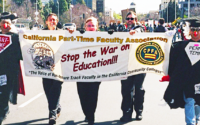
CPFA is working to achieve a basic democratic principle: Equality. CPFA seeks to eliminate the inequality faced by part-time faculty when compared to their full-time colleagues by establishing a One-Tier System in the California Community Colleges (CCC), in which faculty with the same qualifications, experience, and responsibilities are supported and compensated proportionately according to their workload.
Part-time parity…raising the cap…it seems like every organization and union in California has their own idea about what will make part-time faculty “more equal” to full-time faculty. Legislatively, these movements have been stopped, some by the Governor himself. Now, all of these organizations have started exploring the idea of moving away from or even eliminating the multi-tiered system. But what does it mean to be “One-Tier”?
CPFA: Past, Present & Future
Saturday, May 10, 2025: 10:00 a.m. — 4:00 p.m. On Zoom
Registration is required, but free and open to all part-time faculty and allies!
By Cynthia Mahabir, Laney College | Originally published in FACCCTS, Fall 2024 The Problem There’s a fundamental weakness in our California Community College system that impairs student success. Fortunately, there’s also a prospective solution. At […]
The Coalition of Contingent Academic Labor (COCAL) is a network of North American union activists who have worked for over 30 years to defend higher education rights and improve work conditions for contingent academic labor by bringing together activists from numerous unions across the United States, Mexico, English Canada, and Quebec that works to promote the sharing of information and strategies to strengthen our capacity for action. COCAL XV conference was held in Gatineau, Quebec on August 8th and 9th, 2024, with a focus on the many issues specific to contingent academic labor and the means faculty can use to mobilize directly against threats to our work conditions and our representation in universities, colleges, and community colleges.
By Geoff Johnson, Originally published on July 30, 2024 at CFT.org CFT’s One-Tier Task force and CFT members, after over eight months of discussion, has created a definitive list of basic components deemed essential for […]
The California Community Colleges (CCC) system plays a pivotal role as an engine for economic and social mobility in California and as a driver for the fifth largest economy in the world. In the past two decades, the CCC system has undergone significant “reform,” narrowing students’ educational opportunities and shrinking the student body by over one million students. During this period, the CCC system’s student outcomes have declined, stagnated, or only slightly improved despite decades of “reform” efforts. This paper illustrates that transitioning from a two-tiered to a nontiered—unified faculty—model will better serve students, colleges, and the state of California. The concept of a unified faculty emphasizes the elimination of the two employment tiers—part-and full-time faculty—to create a nontiered structure. This model is based on faculty and collegewide unity as opposed to the current structure that has produced a divided faculty, inequitable service to students, and stagnant or diminishing student outcomes. Presently, the K-12 system and Vancouver model are structured around a unified, nontiered faculty model. It is time for the California Community Colleges to address the hypocrisy at the heart of its institutions: decades of disinvestment from the faculty and thus, students. Investing in a nontiered, unified faculty model will remedy the CCC system that is currently struggling to bring back the millions of students who have been pushed out of their colleges.
Assembly Bill 2277 (Wallis), our bill to raise the part-time teaching cap from 67% to 85% of a full-time course load, is now going through the political process in Sacramento. (For more on this bill, […]
On Saturday, April 20th, 2024, from 10:00 a.m. to 4:00 p.m., the California Part-time Faculty Association (CPFA) will be hosting its annual conference virtually via Zoom. This event is free and open to everyone, but […]